
NomadWealth: Self-Hosted Net-Worth App
Turning a personal finance dashboard into a self-hostable product: holdings, real estate, loans and cash in one private cockpit, deployed to the buyer’s own Vercel so the vendor never sees their data.
Project overview
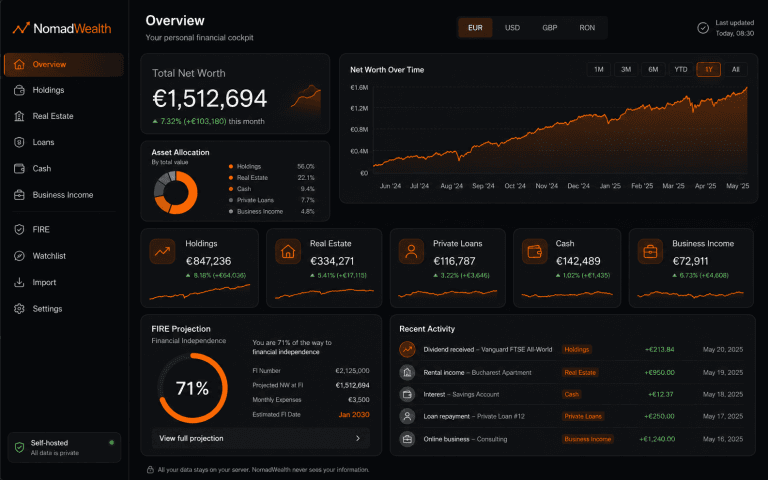
NomadWealth is a self-hostable personal net-worth and investment cockpit — one private dashboard for your entire financial picture, not just your stocks: EU, US and Bucharest-listed equities, crypto, funds and gold alongside real estate, private loans, cash, business income and a FIRE projection, all switchable live between EUR, USD, GBP and RON. It began life as a single-user, env-password personal dashboard I built for my own finances, then I packaged it into a sellable product that each buyer deploys to their own Vercel and connects to their own Neon Postgres. It now ships in two tiers: a free Lite deploy that needs no key and no card, and a Pro license at a flat €149 with free updates for life — no renewal, no subscription.
The defining constraint shaped every decision: as the vendor, I literally cannot see the buyer’s data. It lives in a database only they hold the keys to, reached only by code running in their account. This phase turned a working personal tool into a productised, one-click-deployable app — a setup wizard, an in-browser importer, offline license activation and a marketing site — added around the existing domain features rather than on top of a rewrite, and then kept shipping: a year-end tax pack, automated data-health checks, return attribution and a fair free tier all landed on the same architecture. The work overlaps most closely with custom Next.js development, product engineering and privacy-first architecture.
The challenge
A dashboard I’d written for myself worked, but it was single-user, assumed one hard-coded password and one database, and stored secrets in environment variables. To sell it, I had to make it something a non-technical buyer could stand up in minutes and trust with their most sensitive data — without gutting the domain features that made it useful in the first place.
Ship a commercial product where the vendor structurally cannot access any customer’s financial values — no analytics, no error payloads, no phone-home.
Take a buyer from “click deploy” to a working, signed-in, multi-currency dashboard with no shell, no manual migrations and no config files.
Add licensing, multi-tenancy-of-one, setup and import around the existing net-worth engine while preserving its data model and behaviour.
Verify a paid license offline on an install the vendor can’t reach — and tier a free version of a source-available app in a way that stays honest when every buyer can read the enforcement code.
What was delivered
I built the packaging layer additively on top of the personal dashboard, keeping the “no vendor data access” invariant as a hard rule that every new feature had to respect. That included a one-click Vercel + Neon deploy, a guided setup wizard, runtime database migrations that need no dev tooling, offline Ed25519 license activation, a privacy-preserving in-browser importer, a free Lite tier with server-side entitlements, and a public marketing and security site — while the domain cockpit itself gained live prices, alerts, sharing, return attribution, data-health auditing, a year-end tax pack and a one-click export.
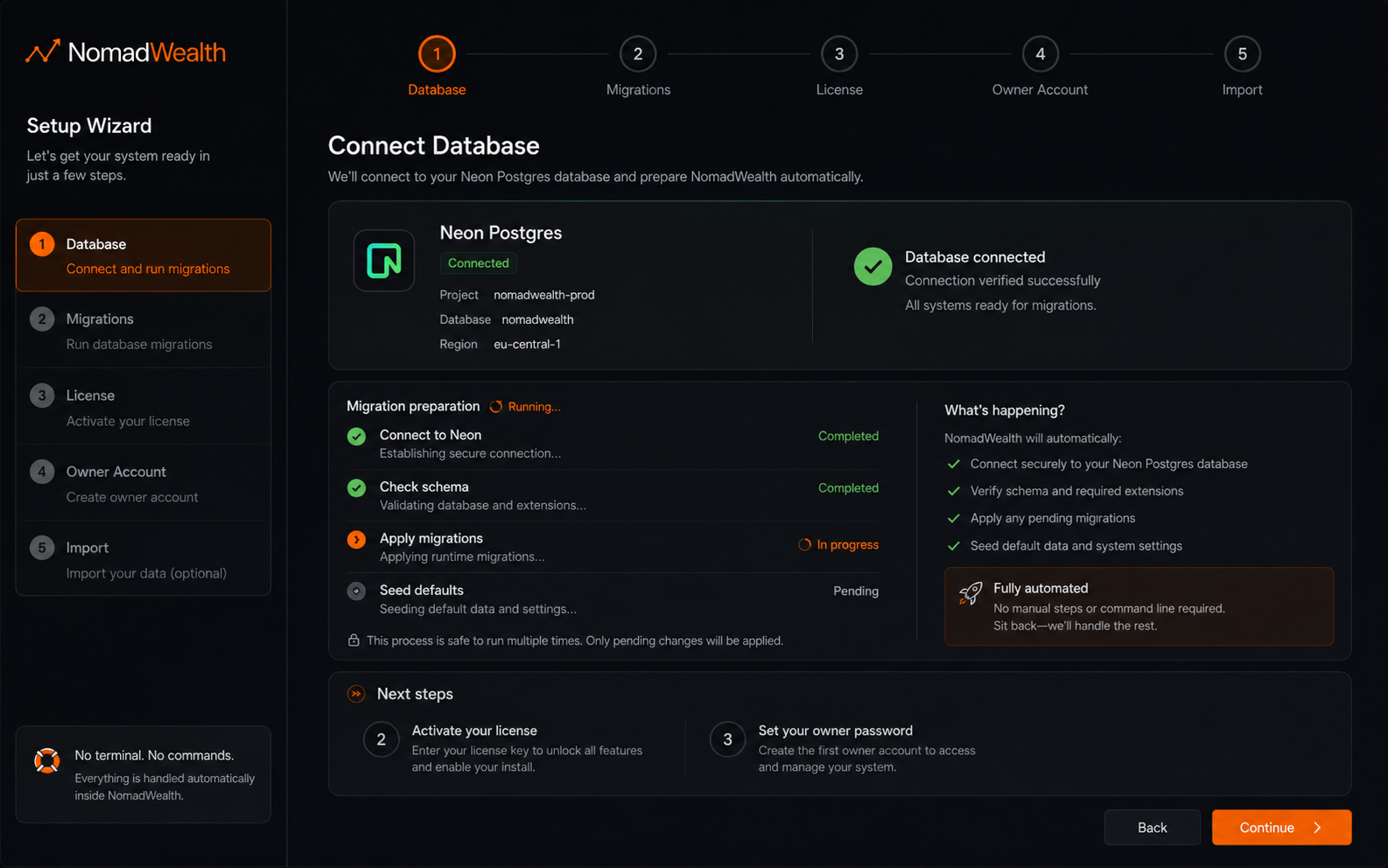
A Deploy-with-Vercel flow provisions a fresh Neon Postgres via the native integration, injects the connection string and boots straight into the setup wizard — now documented screen-by-screen in the README.
A first-run wizard confirms the database, runs migrations, activates the license (or continues free on Lite), sets the owner password and offers a CSV/Excel import or an empty start.
Ed25519-signed keys verified against a public key embedded in the app, with an optional opaque revocation check that sends only the key — never data. Every key is perpetual: updates are free for life.
Spreadsheets are parsed entirely client-side, mapped and previewed in the browser, then committed per asset class — financial values never touch a vendor server.
Core functionality included
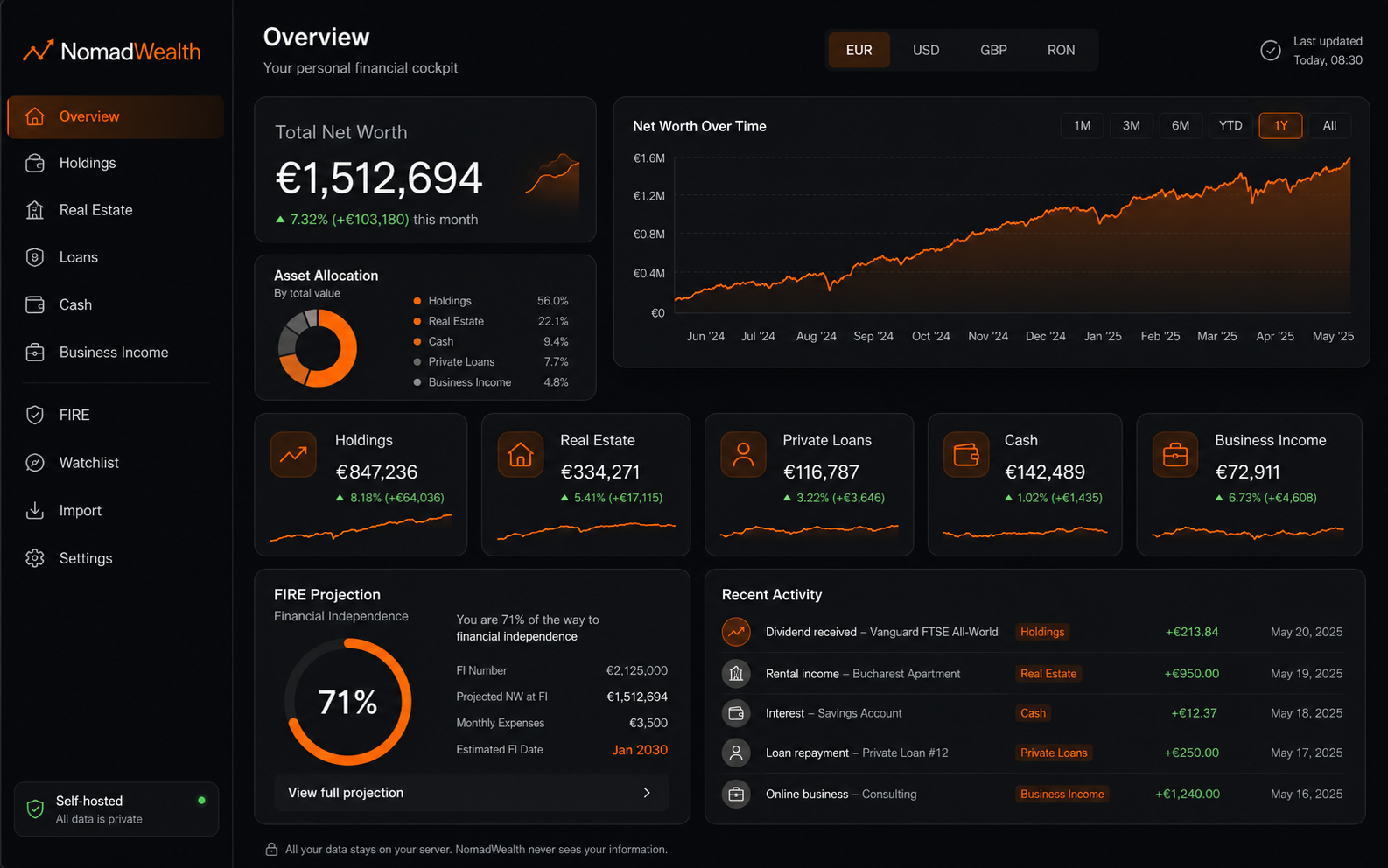
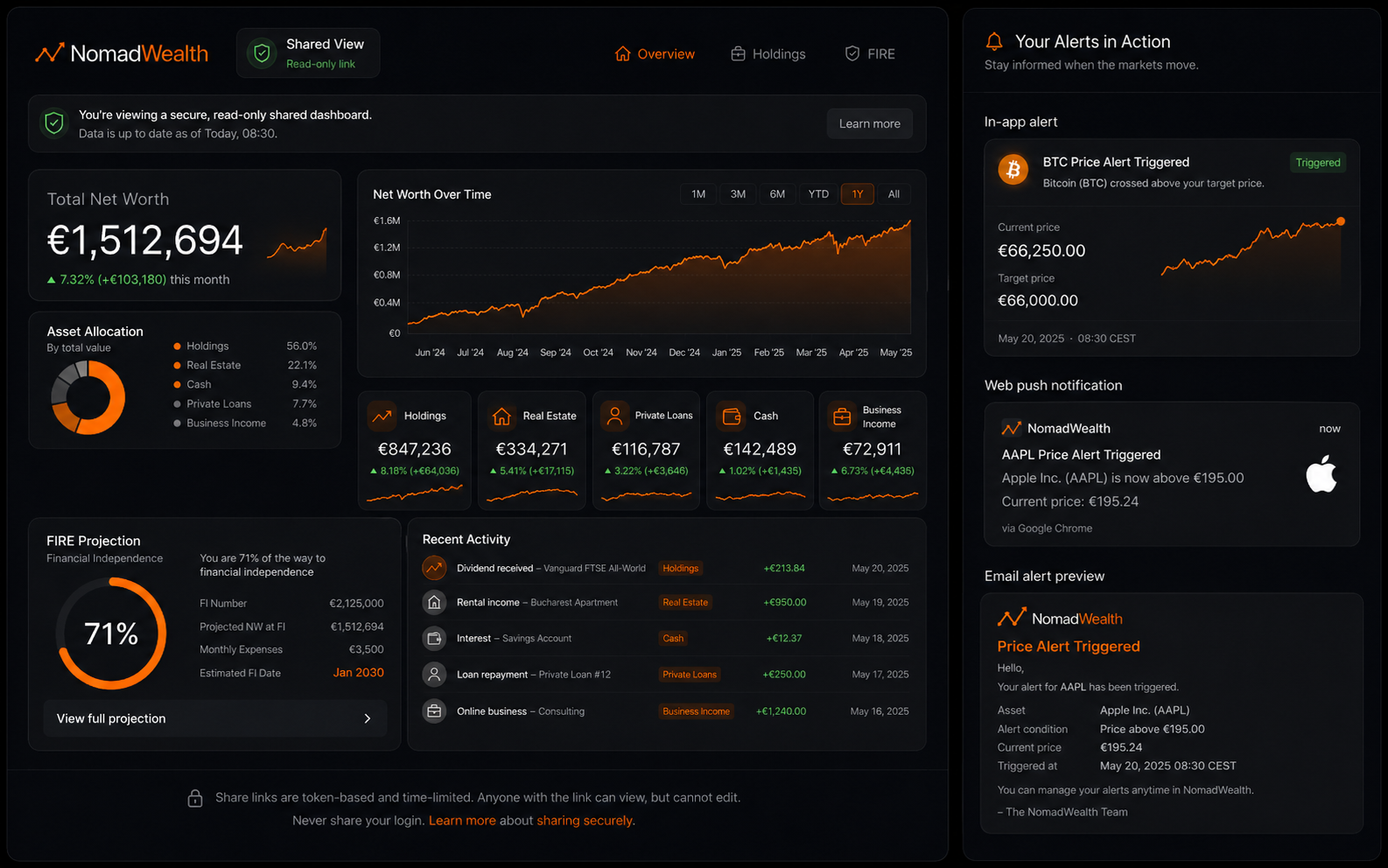
Public holdings across eight instrument classes — EU, US and Romanian stocks, crypto, REITs, funds and gold — plus real estate, private loans, cash, business income and freelance clients roll up into one live total, with a true 30-day net-worth delta and property values interpolated over time on the trend chart.
The whole cockpit re-denominates instantly between EUR, USD, GBP and RON using keyless Frankfurter FX rates — no page reload, no vendor key required — and names your home-market concentration by the currency your assets actually trade in.
US, EU and Bucharest-exchange equities price from Yahoo (keyless); crypto uses the buyer’s own optional key, refreshed by a daily authorised cron.
A reproducible record for a tax preparer — capital gains, dividends, loan interest, rent and business income, each line converted at its own event-date FX rate with the rate recorded, and anything unrepresentable listed explicitly. Deliberately a record of what happened, never a tax computation.
Twelve read-only checks catch what quietly breaks the numbers — selling more than you bought, a price typed into a quantity field, rent that stopped arriving — each with a severity, a quantified EUR impact and a deep link to the row that needs fixing.
The Performance tab attributes realised returns by holding period, with win rate and capital velocity, so the owner can see which kind of trade actually makes them money.
A financial-independence projection models growth against a target so the owner can see their trajectory, not just today’s balance.
Private loans accrue interest, track expected vs actual receipts and compute an effective annualised yield (IRR) over real cashflows — all unit-tested pure functions.
Dividends and loan interest roll into a realised year-to-date income figure kept strictly separate from realised trading P/L and unrealised gains, with average-cost aggregation per symbol.
A watchlist plus threshold price alerts, evaluated server-side and delivered via Web Push and email so the owner is notified without opening the app — alongside a weekly net-worth digest and milestone notifications.
An eye toggle masks every money figure in one click, and read-only share links — gated by a 256-bit token whose SHA-256 hash is all the database stores — can force “hide all amounts” per link, so a viewer sees structure and performance but never a balance.
A hashed owner password (PBKDF2 via Web Crypto) set in the wizard, optional TOTP two-factor with QR enrolment, login rate limiting, session revocation and strict security headers.
An owner-only export streams every financial table out of the buyer’s own database, deliberately excluding secrets — their data is never locked in.
Records soft-delete via
deleted_at and land in a recoverable trash view rather than being destroyed.A web manifest, theme-color and Apple web-app metadata make the cockpit installable to the home screen.
SEO-optimised
/welcome, /cockpit showcase, a click-through live demo with European sample data, comparison and changelog pages, and a /security page that states the no-data-access guarantee plainly — all served only on the vendor domain, so a buyer’s install never carries someone else’s advertising.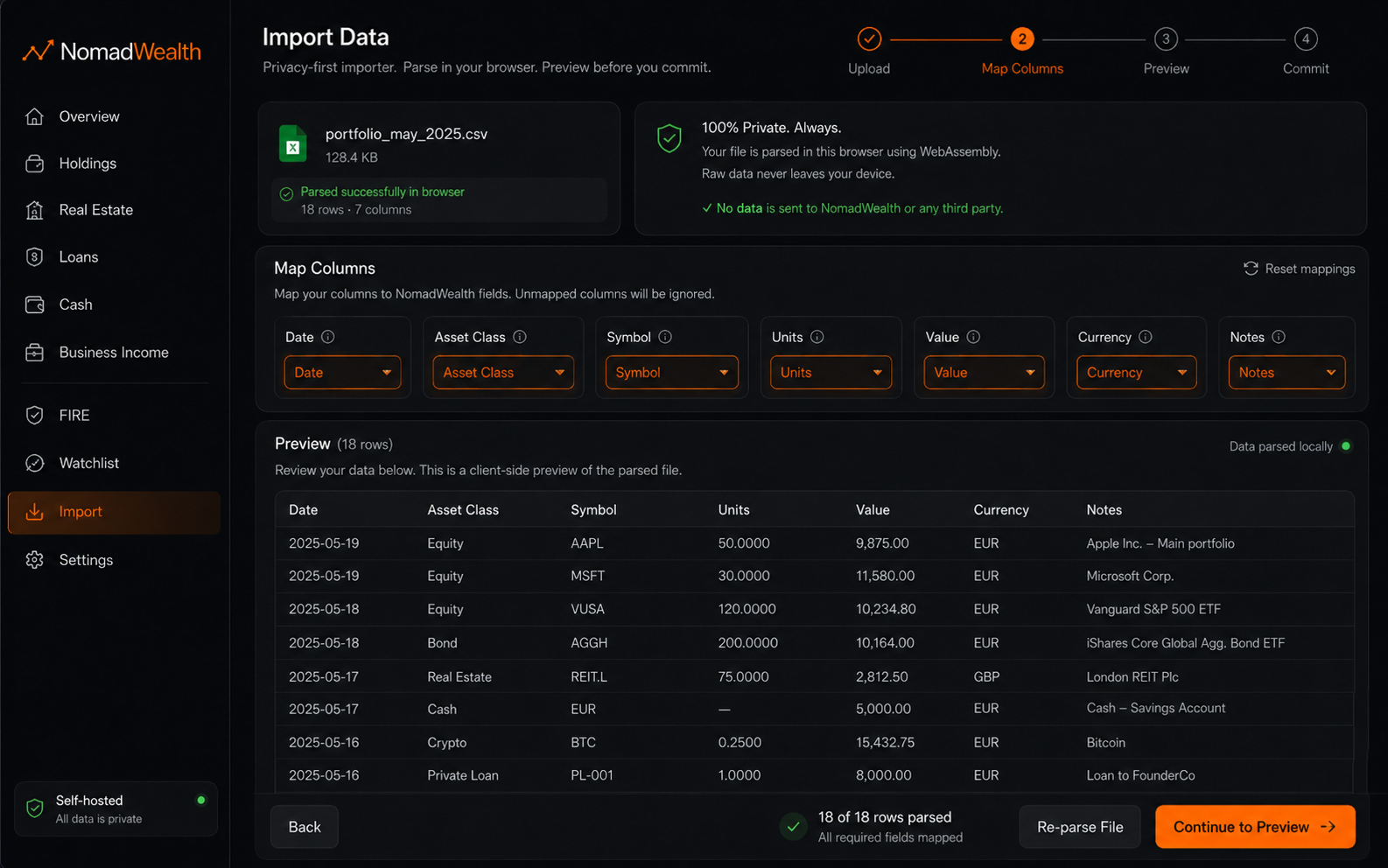
Key architecture decisions
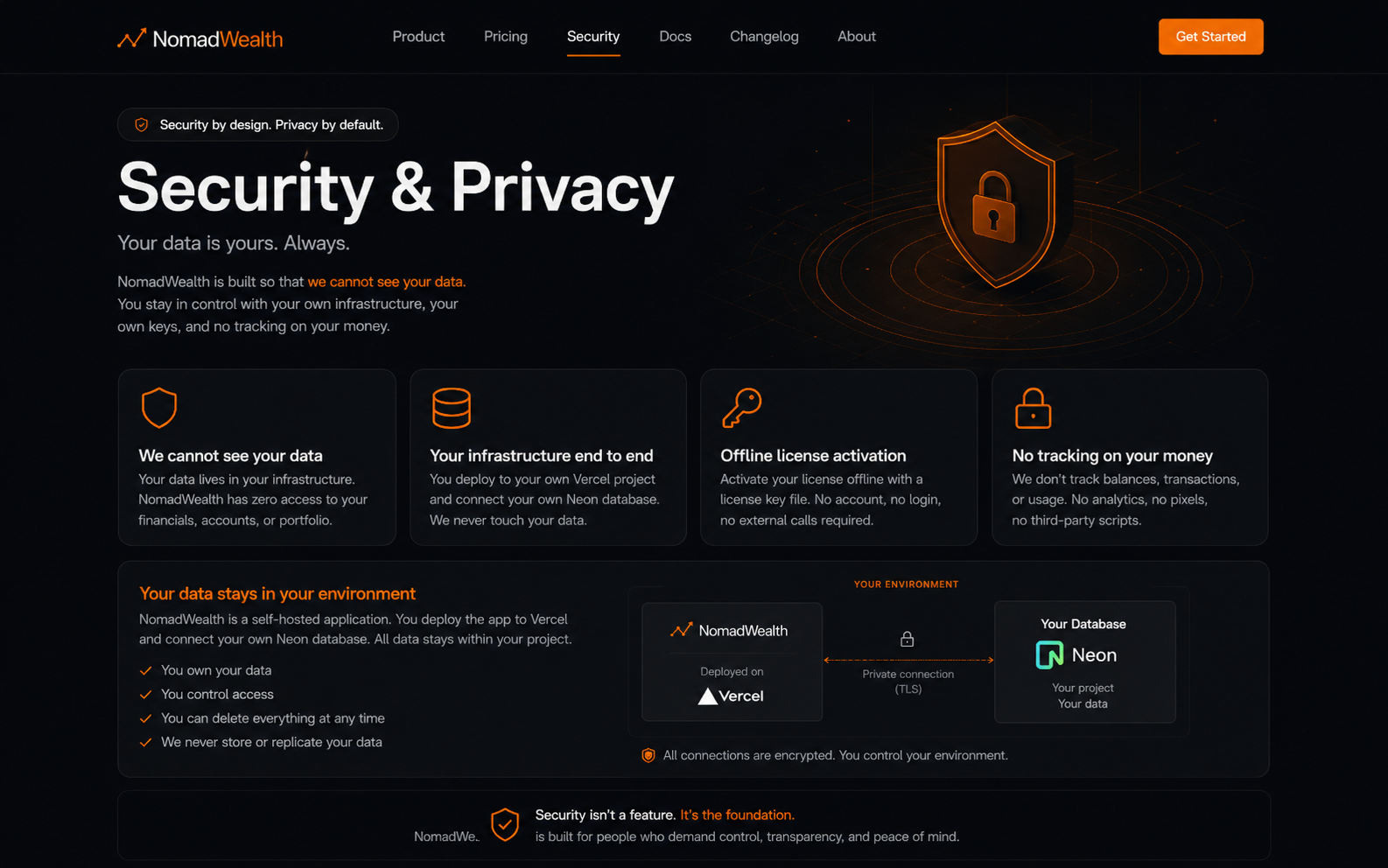
The guiding principle was to extend, not rebuild. The personal dashboard already had a working net-worth engine, a Drizzle/Neon data model and a session mechanism, so productisation added a thin packaging layer — licensing, setup, import and marketing — with almost no change to the underlying domain schema. The non-negotiable invariant sat above everything: the vendor can never see buyer data, which ruled out conventional analytics, error reporting with payloads and any license server in the hot path.
Three decisions did the heavy lifting. First, migrations run at runtime over the Neon driver rather than through drizzle-kit — the SQL is embedded into the app, applied by the setup wizard on first run and automatically on the first request after any later deploy, tracked in a bookkeeping table and tolerant of “already exists” so it stays idempotent on restricted serverless hosts. Second, a first-run guard in middleware redirects every route to /setup until the install is configured, then fast-paths warm requests with a signed cookie. Third, licensing is offline by design — keys are Ed25519-signed and verified against a public key baked into the binary, so activation needs no network call at all.
The Lite/Pro tiering that arrived later reuses the same machinery instead of adding any. The tier is resolved from the same offline license state, and entitlements are enforced server-side with one deliberate philosophy: caps apply to creating new rows only. Reads, edits, deletes, export and every security feature stay ungated forever — an install that outgrows the free tier keeps everything it has. Because buyers get full source, enforcement they can read has to be an honest deal rather than DRM, and the code says so in its own comments. Newer analytics — the tax pack, health checks, attribution and yield maths — are pure, I/O-free modules with injected FX resolvers, so every figure that might end up in front of a tax preparer is unit-tested against fixtures.
No analytics on financial values, no error payloads, no vendor services at boot — the app runs with only a database URL and a session secret.
Embedded SQL applied over the Neon driver and tracked in a migrations table means buyers migrate without ever running a CLI — including schema changes shipped long after their initial setup.
Lite caps gate row creation only, never access to existing data; the free tier is the same app, and upgrading is a license key, not a migration.
Ed25519 signatures verified locally; setup re-verifies the signed key server-side and rejects empty or trial keys to close the free-deploy loophole — while Lite makes the free path legitimate instead.
Results and outcomes
The project became a genuinely self-hostable commercial product: a buyer can go from a single click to a working, signed-in, multi-currency net-worth cockpit on infrastructure they wholly own, with the vendor unable to read a single figure — free on Lite, or €149 once for Pro with updates free for life. The domain features I originally built for myself now ship as a polished, privacy-first app that keeps deepening without touching its core.
One-click Vercel + Neon deploy, a guided wizard and offline activation turned a personal tool into something a non-technical buyer can run.
Lite is the same source-available app with honest creation caps — no key, no card, no expiry — turning “try before you buy” into an architectural property rather than a marketing funnel.
Client-side import, offline licensing and zero data-capturing telemetry mean the “we can’t see your data” claim is architectural, not a policy promise.
Runtime migrations remove every CLI step from the buyer’s path, on day one and on every update after — and updates cost nothing, forever.
Every asset class, live prices, FX, income tracking, alerts, attribution and a FIRE projection in one cockpit — with twelve automated health checks guarding the numbers and a tax pack that makes year-end reproducible.
One-click export, soft-delete recovery and never-gated reads mean the owner always controls and can extract their own data — even over a Lite cap.
Technology used
NomadWealth is built with Next.js 15 (App Router), React 19 and TypeScript, styled with Tailwind and shadcn/ui in a dark, cockpit aesthetic with Framer Motion, and charted with Recharts and lightweight-charts. Data runs through Drizzle ORM on Neon serverless Postgres with Zod-validated Server Actions; the financial maths — cost basis, IRR, attribution, tax-pack and health-check logic — lives in pure, unit-tested modules. Licensing uses Ed25519 signatures via the Web Crypto API; owner auth uses PBKDF2 and TOTP; alerts use Web Push (VAPID) and email; FX comes from Frankfurter with per-date historical rates, and prices from Yahoo and an optional buyer-supplied crypto key. It deploys to Vercel via a one-click template and the native Neon integration.
The delivery is most relevant to custom Next.js and full-stack development, privacy-first product engineering and ongoing support for self-hostable SaaS.
Next steps
This case study covers the productisation of a working personal dashboard into a self-hostable, sellable app — and the first rounds of deepening that followed: tiering, tax tooling, data-health auditing and return analytics. The next stage is growth: widening the Lite-to-Pro funnel the free tier opens, broadening market and asset-class coverage beyond Europe and the US, and extending the tax pack and projection tooling — all while holding the line on the no-vendor-data-access invariant.
If you are turning an internal tool into a self-hostable product, or need a privacy-first full-stack build where the vendor genuinely can’t see customer data, the most relevant starting points are usually custom development and ongoing support.
Looking for similar outcomes? Start with SaaS Development and browse more project examples.
Best matched offer
This project is closest to SaaS Development. Start there if you want a similar outcome.
Newsletter
Get the free WordPress SEO checklist
Plus one practical fix a week, with lessons from real builds like this one.
What this proves
This project shows the kind of commercial problem the work is built around: clearer implementation, fewer technical compromises and a better path from website investment to business outcome. If you need a similar approach, explore SaaS Development and practical implementation guides.
Keep exploring
Recent work
All case studies
TQ Legal: Rebranding a Live Barrister’s Website Without Breaking It
A complete rebrand of a live barrister’s WordPress site, shipped as an additive component layer alongside the legacy theme so nothing already live ever broke. A token-driven design system, a fully editable ACF page builder and a measurable enquiry journey, all with a zero-downtime rollout.

Guided Experience Platform
A mobile-first WordPress and PWA platform for self-guided in-venue experiences, designed to feel app-like, flexible across brands and easy to manage.
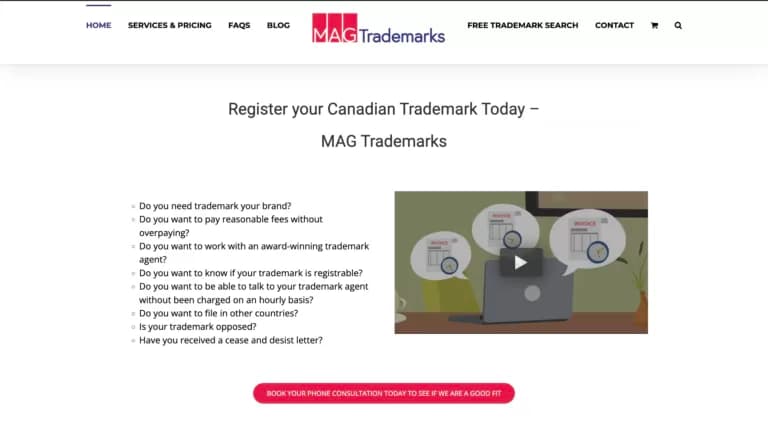
MAG Trademarks
An ecommerce-focused WordPress site for trademark services, supported with ongoing improvements and care plan support to keep the platform effective and current.
Services
All servicesReading
All articlesHow to Turn Your WordPress Website Into a Progressive Web App
How a Progressive Web App can turn a WordPress website into a faster, app-like experience with home screen access, alert
Clearing Your WordPress Admin Dashboard: How to Remove Plugin Ads
A simple WordPress admin tweak that hides plugin ads and notices to create a cleaner dashboard, while also highlighting
Fixing YouTube Link Conversion in WordPress & BuddyPress
A lightweight WordPress customisation that automatically converts YouTube links into embedded iframes across posts, bbPr
Want Similar Results for Your Business?
Let's discuss how I can help scale your website with a custom solution tailored to your business needs. From performance optimization to complete redesigns, I deliver results that drive growth.
Free 30-minute consultation • No commitment required • For business ready